The Parishes

About The Group

Hackthorn Village

Hackthorn is situated 7½ miles north of Lincoln just east of the A15.

During Roman times there was a settlement at Hackthorn, forming part of the Lindum Colonia, where soldiers were encouraged to settle on retirements. It is likely that that medieval village later took the place of the Roman settlement, being sited both where the present village stands as well as north of it, as excavations have revealed an almost continuous series of building foundations.

Hackthorn is mentioned in the Doomsday Book, and the name Hackthorn may be from the old English words 'haca' (a hook or bend), or from 'hagathorn' (hawthorn).

A central part of the village is Hackthorn Estate.

More information about Hackthorn will appear here when it is available.
Contact us now if you can tell us more about the village

St. Michael and All Angels Church

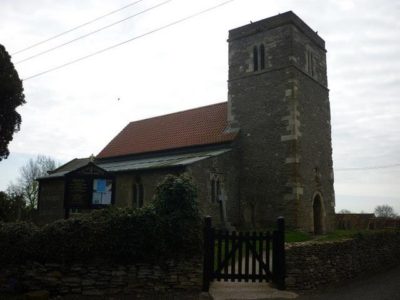
The only remnants of the earliest church on this site (mentioned in the Doomsday Book), are the two arches that are incorporated into the North and West doorways of the present building, and some thick stone slabs of Saxon origin that were found when the present foundations were being laid.

See the photo album for more pictures of St. Michael and All Angels Church

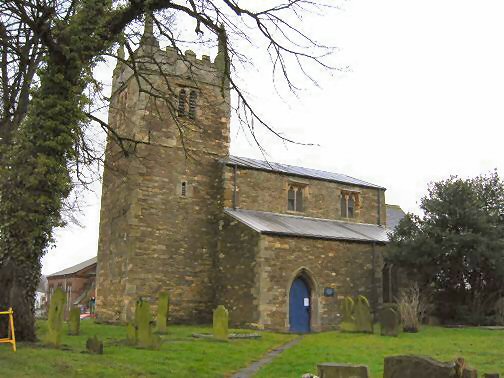
St. Michael and All Angels Church - Hackthorn

Saxby Village

Saxby is a small village situated ten miles north of Lincoln, overlooking the upper Ancholme valley. There is evidence that the areas was occupied in Roman times. The name "Sassebi" is recorded in the Doomsday book, and thus probably occupied by Danish invaders in the ninth century. Saxby passed into the ownership of St Katherine's Priory, Lincoln, during the twelfth century. St Katherine's was a hospital for the poor and sick, and was administered by Gilbertine canons and nuns.

For 450 years Saxby has had close connections with the Earls of Scarbrough and their predecessors, the ancient family of Saunderson. The estate was finally sold in 1917, but the connection was continued until the death of the 12th Earl in 2004. He was the last Scarbrough Patron of St Helen's Church and Lord of the Manor.

More information about Saxby will appear here when it is available.
Contact us now if you can tell us more about the village

St. Helen's Church

Little is known about the original church which was on the same site as the present building. Parish records indicate that the old church was the last resting place of several members of the Saunderson family and the 3rd Earl of Scarbrough. The nearby village of Firsby had a church, St James' mentioned in the Doomsday Book, but nothing remains of the site of the medieval village of Firsby, about one mile south-west of Saxby. The church of St Helen was completed in 1775 and was built as a parish church and mausoleum chapel for the Lumley Saunderson family. The architect is thought to have been Thomas Lumby, who also rebuilt the roof of the Chapter House in Lincoln Cathedral. In 1869 one of the south windows was replaced with a stained glass memorial window to John Wheelwright Robinson, who lived at Saxby Manor and is buried in the churchyard.

Over the years the interior decoration had altered considerably from its original colour scheme. In 2004, Nigel Leaney carried out detailed paint samples in the church and was able to produce the original colour scheme from 1775. In 2005 the church was redecorated with this authentic colour scheme with the help of a Heritage Lottery Fund grant, and it is now possible to enjoy the church as it was in 1775.

The memorials in the church are to the 6th, 7th and 8th Earls of Scarbrough and the 7th Countess. The hatchments at the rear of the church are the armorial bearings of Richard the 6th Earl who died in 1832, and John the 8th Earl who died in 1856.

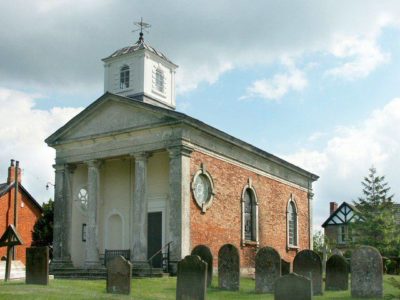
The present church stands in an elevated position overlooking open countryside to the west. It is built of stone and brick, in a classical style, with a lead roof, and a timber and leaded cupola. The magnesium limestone used in the building for the base, portico, columns, window surrounds and copings was probably quarried and cut at the Roche stone quarry in South Yorkshire. The red brick most likely came from a local source.

The interior consists of a central aisle leading to the semi-circular altar apse. When the church was built there was a window in the east end behind the altar. The apse was altered in 1869 and the window was filled in and plastered over. At this time the apse was given its present boss and acanthus leaf pattern. There was also a Victorian mural painted on the wall behind the altar.

See the photo album for more pictures of St. Helen's Church

St. Michael's Church - Saxby

Spridlington Village

Spridlington is located 8 miles north of Lincoln - just off of the A15.

More information about Spridlington will appear here when it is available.
Contact us now if you can tell us more about the village

St. Hilary's Church

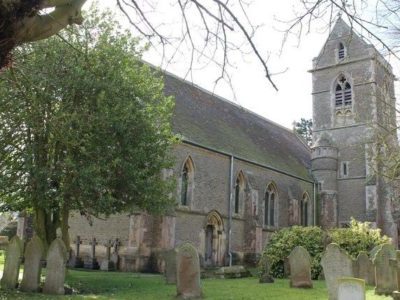
The present church dates from 1875, and was designed by James Fowler of Louth (1828 - 1892). It was built to replace an earlier church, which was dedicated to St. Hilary and St. Albinus. This name itself was due to the fact that there had originally been two churches in the village; St. Hilary and St. Albinus. The site of St. Albinus is not recorded. It is built almost entirely of local blue Oolite stone, dressed with Ancaster stone, and is in the geometric style of gothic architecture.

The church as it is today was built in memory of the Rector, Rev H F Hutton, who was incumbent for thirty-two years. A brass plaque commemorating this can be seen on the west wall by the door. The design of the church follows a simple box plan, which is 70 by 28 feet, with no separate chancel. This was done intentionally so as to avoid aisles that would obscure sight and impede hearing. The Rector in 1875, Rev Arthur W Hutton (son of the former rector) observed "that experience must decide whether the effort has been successful".

The font stands on a plinth at the west end. The west end stained glass windows depict the early life of Jesus, and are colourful and detailed. There is a rose window above. This was re-leaded in 1993.

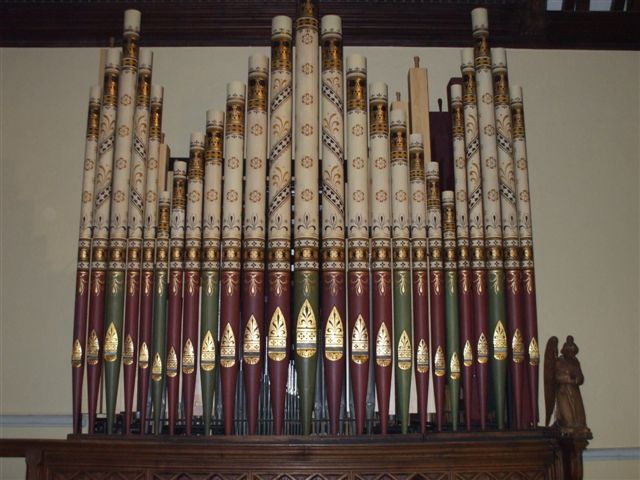
The chancel makes good use of wooden panelling, The cancellum screen has wrought iron gates and three steps, creating the chancel area. The side panelling forms the vestry and organ loft. The historic organ is due to be restored as soon as the funds have been raised. There are good oak carvings of angels either side of the chancel, which were carved by the same sculptor who carved the figure of Christ the Good Shepherd by the entrance.

The east window shows the figure of Christ in Majesty, with St. Peter and St. Paul on either side, and St. Hugh of Lincoln,. St. Hilary and St. Gregory below. Many features in the church indicate the influence of the Oxford Movement of the 19th century.

The organ is a fine example built by Nicholson of Lincoln. Records show that it cost £300.00 in 1875. It is built into an arched recess in the south wall. When built, it had 894 pipes, eight stops on the Great Organ, six on the Swell, and a Bourdon stop with octave pipes on the Pedal Organ. Over the years the pipes have been reduced in number and it now has 732. The organ was last overhauled in 1983 by Henry Groves of Nottingham. One expert has described it as "...a lovely little instrument, with strong, lively chorus work and splendid quiet stops."

Read about the Organ Restoration Project

The bell dates from 1802 and bears the inscription "J Harrison facit. William Morris, Church Warden 1802". The bell was re-hung in 1992. Rev A W Hutton noted that "there is ample room and strength in the tower for a peal of six or eight bells, which perhaps will find their way here some day." The tower is 65 feet high, although this appears higher due to the elevated nature of the church yard. It has a 'saddleback' roof, similar to those found in Normandy and along the Rhine.

Above the doorway in the north tower wall is a niche containing the figure of Christ the Good Shepherd, carved by Ruddock. The tower clock was a memorial gift from the Spridlington farmers and was made by J Bailey & Co of Salford, Manchester. The Priest's Door contains a carving of St Hilary, Bishop of Poitiers, born around 300 AD in France.

See the photo album for more pictures of St. Hilary's Church

St. Hilary's Church - Spridlington

Upcoming Events

Saturday 24th May, 2008

Farwell Concert - Roxy Summerfield & friends

Friday 20th June, 2008

A demonstration of the restored organ for the Industrial Heritage section of the University of the Third Age, Welton Branch

Friday 3rd October, 2008

Lincoln Cathedral Girls Choir, Director Aric Prentice

Owmby Village

Owmby by Spital is 9 miles north of Lincoln just off the A15.

More information about Owmby will appear here when it is available.
Contact us now if you can tell us more about the village

St. Peter's and Paul's Church

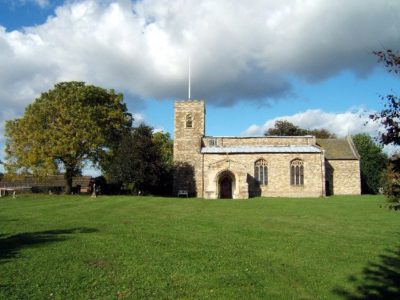
St Peter's and Paul's church is mostly Norman, with the entrance to the building being at the base of the tower at the west end. The tower has three bells dating from 1687, only one of which is in use at present. A fine 12th century arcade separates the nave from the aisle, and its pointed archers rest on pillars with large bases. The capitals are decorated with bold leaf carvings. The chancel was added later, and the glass in the east window dates from 1958.

The church has required substantial renovations at various times. In 1845 Archdeacon Stonehouse reported that "Owmby Church is an old ruinous fabric, held together by the lead covering the roof." The roof itself did then collapse in 1939, revealing beams and rafters that had been ravaged by woodworm. Repairs were rapidly carried out, and by January 1940 a new roof and been constructed above the nave, aisle and tower.

Further work was carried out in 1972, including renewal of stonework, re-hanging of the bells, installation of heaters and redecoration.

In 2000, the church was re-roofed. Although occasional financial aid was received, the majority of the work was funded through the generosity of the local community. In 2003, £1600 was raised from a Flower Festival for the redecoration of the Church. However, preparatory work suddenly uncovered the need for urgent structural repairs: Lintels over two medieval windows were close to collapse; one window was collapsing outwards; and some walls not joined to one another and were moving apart.

A scheme for the works was prepared. Substantial grant aid was received from ten grant giving trusts, and fundraising took place locally. The work was carried out, and the church was redecorated in 2005. To celebrate the completion of the work, John, Bishop of Lincoln, led a Songs of Praise service in Owmby Church in May. More external repairs which include the provision of new gate posts, a ramped path, re-pointing, stonework, a new vestry door, and lead work is still due to be carried out.

The inscriptions on the three bells read:

Let us remember the 5th of November WSHW 16687

When you die aloud I cry WSHW 1687

God save the King WSHW 1687

(WSHW refer to the bell founders William Seller of York and Humphrey Wilkinson of Lincoln)

See the photo album for more pictures of St. Peter's and Paul's Church

St. Peter's and Paul's Church - Owmby

Glentham Village

Glentham is on the north side of the A631, about 14 miles north of Lincoln.

More information about Glentham will appear here when it is available.
Contact us now if you can tell us more about the village

St Peter's Church

The nave and aisles in St Peter's Church, Glentham, date from the 15th century, but the church was substantially restored in 1855, and the south aisle was further improved in 1936. A plaque on the east wall notes these dates. The windows are Perpendicular in the north and south aisles, with two earlier lancet windows in the west end. The stained glass window in the north wall shows St George and the Dragon, and is a memorial to Sir Montague Chomeley of Norton Place, killed in the First World War. It was designed by Christopher Whall (1849 - 1924) who was the principal teacher of Stained Glass Design at the Royal College of Art and the Central School of Art and Craft. Other works by Whall can be seen at Southwell Minster, Gloucester Cathedral and in the USA.

The pulpit is a further memorial by George Jack (1855 - 1931), who was a colleague of Whall.

The Vestry was a mortuary chapel of the Tourneys, and also contains a 14th century brass located in the north-east corner.

It seems that the east end of the church was shortened, possibly in the 17th century, and an incomplete arch can be seen on the North side. The east window in the Chancel dates from about 1900. There is an ancient Priest's Door in the South wall.

The box pews are Georgian.

The organ is situated in the gallery at the west end, and was built by Foster and Andrews of Hull. It cost £80.00 in 1836, and was originally situated at the east end of the south aisle. There are four bells in the tower, which were cast in 1687. The carved chest in the south aisle is very old, probably dating from the 14th century, with some later restorations. It is a clamped chest with framed ends made of riven oak and still with the original lock. The softwood lid and hinges are a 17th or 18th century repair. Inside is an original candle box. There is brass to Elizabeth Tourney, who died in 1452 and another to Anne Tourney dated 1641.

The list of Incumbents shows the first rector as Geofrey in 1190, and the first vicar as Richard de Stamford in 1273. In the east wall of the north aisle there is a recess for a Reredos, probably used originally to accommodate statues of the twelve apostles.

The font has a 12th century base with a circular still leaf capital. The top section was added in 1916.

Under the organ loft lies an old stone effigy known as Molly Grimes. The ancient ritual of washing holy images on Good Friday was perpetuated in Glentham until 1832, using this effigy. A rent charge of seven shillings a year had been left on some land to pay seven virgins to perform this task, the water being carried from the well near Caenby Corner. When the land was sold in 1832 with no reservation on this rent charge, the custom fell into disuse.

Above the porch entrance can be seen the Tourney coat of arms - three bulls with chevron band, and a 15th century pieta. The medieval door contains its original sanctuary ring. In the west end of the churchyard stand two rare black walnut trees which were planted in 1930.

The 13th century tower was repaired in 1756 and again in 1989. The clock, made by T M Hartley of Shillingford, was installed in 1921 as a War Memorial, and has to be wound every six days. On the east wall of the vestry is a small area of typical Norman stonework in the chevron pattern. In 1995 major repairs were carried out, including re-pointing and replacement of stones.

See the photo album for more pictures of St. Peter's Church

St. Peter's Church - Glentham